
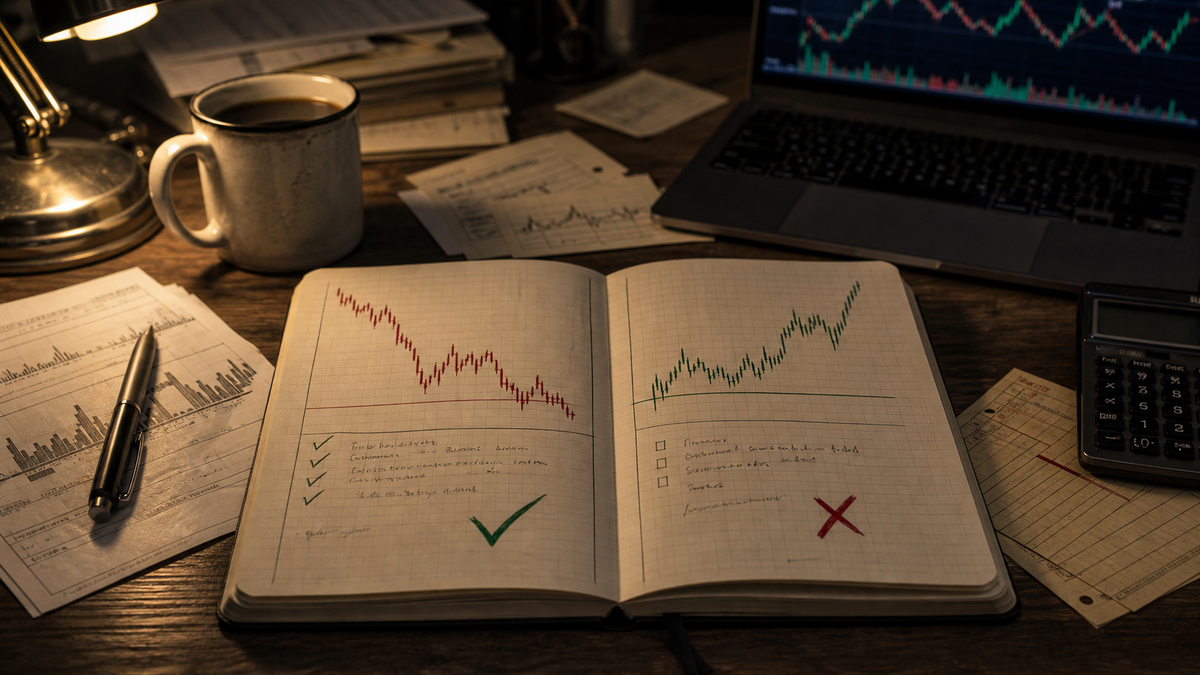
The trade made money.
That may be the problem.
In a recent FundSeeder interview, Jack Schwager comes back to a point that sounds simple until there is real money attached to it: a trade is not good because it won, and it is not bad because it lost.
Most trading journals get this backwards. They start with the visible result. Green number, good trade. Red number, bad trade. Maybe there is a screenshot, maybe a note about hesitation, maybe a sentence about "discipline" written after the damage is already done.
The account has already voted, so the trader lets the verdict stand.
The harder standard is this: grade the trade by whether the trader did what he was supposed to do. Then record the money.
That leaves room for two facts every trader says he understands and then forgets under pressure:
A good trade can lose.
A bad trade can win.
Trading Lets Ignorance Win For A While
Schwager makes the profession point sharply.
A person with no medical training does not walk into a hospital and perform brain surgery. A person who has never played violin does not stand up with the New York Philharmonic and survive the solo. In most fields, ignorance fails immediately.
Trading is different. The market can pay ignorance for a while.
In a strong bull run, a beginner can buy whatever is going up and feel gifted. In a bubble, bad process can look like instinct. A rising tape can hide bad entries, no risk plan, position size chosen by mood, and a complete lack of exit rules.
Then the regime changes and the old lesson becomes expensive.
Trading fools people faster than many other fields because the feedback is noisy. The reward can arrive before the skill does. If the trader uses only P&L as the teacher, he can learn exactly the wrong thing.
The Journal Mistake
The usual trading journal records the part that is easiest to write down.
Entry. Exit. Profit. Loss. Maybe a screenshot. Maybe a note about emotions if the trader is feeling especially honest.
Better than nothing, but it still misses Schwager's main test: was the trade executed according to the plan?
Schwager gives the simple example. Suppose a setup has favorable odds over time. It wins half the time, and the average winner is twice the average loser. If the trader takes the setup correctly and the trade falls into the losing half, he did not make a mistake. He took a normal loss inside a positive process.
A trader can also break every rule and still make money. He can move the stop, add out of frustration, chase late, double size, ignore the exit, and get bailed out by one friendly candle.
The account says winner.
The journal should say problem.
That is the trade worth circling in red, not celebrating.
Score The Process Separately
A cleaner journal has two scores.
Outcome: win, loss, flat.
Process: followed plan, bent plan, broke plan.
Those two scores should not be merged. A losing trade can be a good trade. A winning trade can be trash. The trader has to see both, or the journal becomes a scoreboard.
Before the trade, the journal should answer five plain questions:
- what was the setup;
- what had to happen for the trade to be valid;
- where was the trade wrong;
- what size was allowed;
- what rule would force an exit.
After the trade, the review can stay plain:
- did I take the trade for the stated reason;
- did I size it according to the plan;
- did I move the stop;
- did I exit according to the rule;
- did I do anything I would not want repeated 100 times.
If the answer to the last question is yes, the P&L should not be allowed to clean up the story.
Bull Markets Are Bad Teachers
Schwager also repeats the old warning not to confuse brilliance with a bull market.
It keeps earning its repeat.
A bull market makes traders feel selected. The account grows. The trader gets bolder. The story becomes cleaner. He starts to believe he saw something that was partly just a rising tape.
This does not mean every bull-market profit is fake. It means the trader has to separate skill from wind at his back.
The journal can help here, but only if it records conditions. Was the trade long-only during a broad rally? Was every similar stock working? Did the position make money because the setup was precise, or because everything with a pulse was being bought?
The answer changes what the trader should trust next time. If the market paid him for risk exposure, that is not the same as paying him for trade selection.
Drawdown Belongs In The Journal Too
The interview gets more concrete when Schwager talks about drawdowns.
For discretionary traders who feel out of sync, he describes two common responses: cut size sharply, or step away for a few days. Not forever. Not as drama. Just enough to stop forcing trades while the trader is not reading the market well.
That belongs in the journal too. Most journals have entries for trades. Fewer have entries for the trader's operating state. A lot of damage starts there.
The trader should know:
- how he slept;
- whether he is angry, rushed, bored, or trying to recover;
- whether he is in a normal drawdown or breaking process;
- whether size has been reduced;
- whether he should be trading at all.
This does not need to become therapy. It is a work check. If the trader is off, do not pretend the next trade will repair it.
The Record Still Needs A Backstory
Schwager also says something allocators understand and traders sometimes dislike: the track record comes first.
When someone sounds impressive, the first serious question is whether the record is real. If the statements do not appear, the story gets thin quickly.
But even a real record is not the whole answer. Some records do not scale. Some traders make excellent money in a niche that cannot absorb much capital. Some can trade their own account but change when outside money arrives.
For an independent trader, the same problem appears earlier and smaller. The journal should show not only whether the trader made money, but how. Was it one product, one regime, one lucky run, one oversized bet, one fragile edge, or a repeatable behavior?
A P&L curve without context can flatter the trader almost as much as a bull market.
The Practical Version
Here is the desk version: write the result down last.
Start with the plan. Then write what actually happened. Then mark whether the plan was followed. Only after that should the P&L get its line.
This format is enough:
- setup;
- planned entry;
- planned exit;
- planned risk;
- actual entry;
- actual exit;
- rule followed or broken;
- one sentence on what should repeat;
- one sentence on what should not repeat;
- P&L.
The order is the whole trick. If P&L comes first, it bullies the review. If process comes first, the trader has a chance to learn the right lesson.
Winning trades are not always evidence. Losing trades are not always warnings.
The journal's job is to tell the difference.
Disclosure: Margin of Pain publishes research and commentary about traders, markets, and risk. This article is not investment advice or a recommendation to buy, sell, short, or hold any security, derivative, futures contract, currency, commodity, or asset.
Source trail
- FundSeeder / YouTube, Jack Schwager On The Brutal Truth About Trading Success.
- Jack D. Schwager, Market Wizards.
- Jack D. Schwager, Unknown Market Wizards.
- FundSeeder, official site.
- Margin of Pain, Ed Seykota and the Trade That Does Not Care If You Are Right.
- Margin of Pain, The Stop Has To Be Where The Trade Is Wrong.