
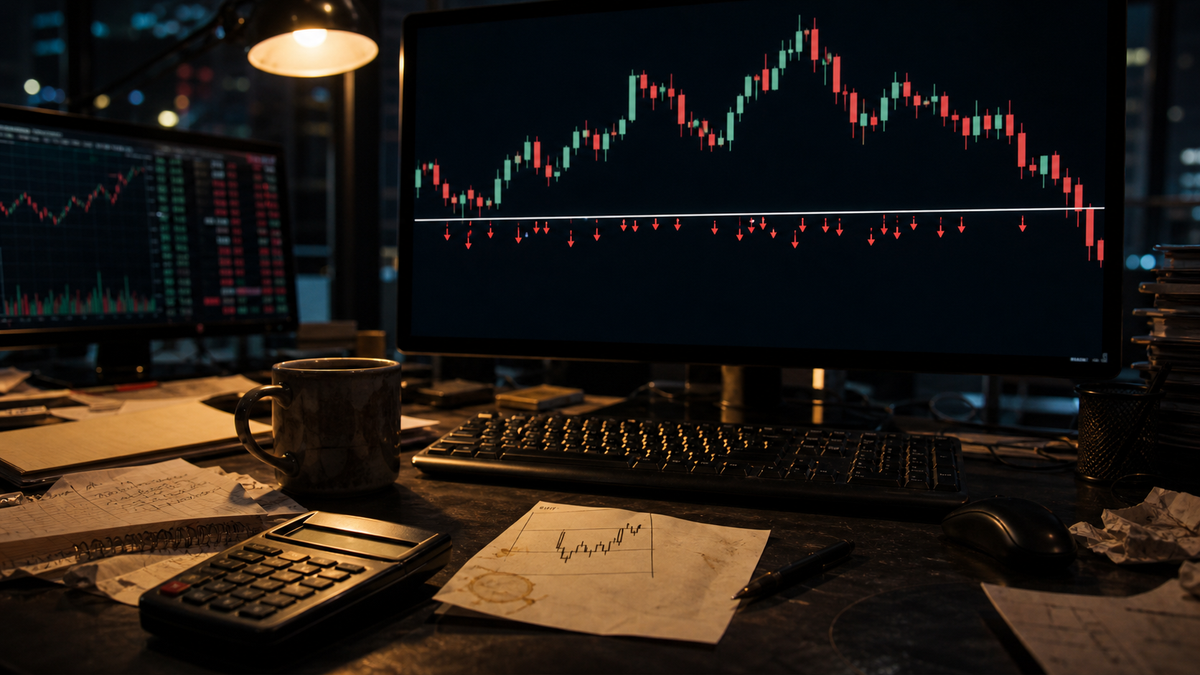
The worst stop in trading is often the one that feels responsible: close enough to make the trade look controlled, small enough to defend as "defined risk," and obvious enough that half the chart is looking at the same place.
Then the market touches it, takes the position out, and goes where the trader thought it might go in the first place.
That is not proof of a conspiracy. It is not proof that somebody saw the order. Usually the explanation is less dramatic. The stop was placed where everybody else could see it.
A recent TradingLab video pulled together old UKspreadbetting interviews on technical analysis, stop hunting, support and resistance, and hedge fund execution. The title asks what hedge funds think of technical analysis. That is the loud version of the topic. The more useful version is narrower: where does a trader put the exit?
The question matters because that is where the money leaves.
A Stop Is Not A Wish
On a retail platform, a stop looks clean. A line. A price. A controlled loss. The screen makes it feel mechanical.
FINRA's basic order-type guide is less romantic. A stop order becomes a market order after the stop price is reached. In a fast market, the execution price can be different from the price the trader had in mind. A stop is a trigger, not a guarantee of dignity.
For futures, the mechanics can be even more specific. CME material on stop orders treats placement as part of the trade plan, not as a number chosen after the fact. In one CME education example, a crude oil stop based on price action carries more risk than a smaller account might want to take. The clean answer is not to drag the stop to a more comfortable spot. It is to avoid the contract, reduce the size, or change the instrument.
This is the part most traders try to negotiate with. They like the entry and the idea. They do not like the dollar amount implied by the place where the trade is actually wrong, so they pull the stop closer and call it discipline.
If the new stop has nothing to do with the trade, it is not discipline. It is a smaller bet on being shaken out.
The Obvious Level Has A Crowd Around It
In one of the UKspreadbetting clips, David Paul of VectorVest describes the retail habit plainly: traders often wait for confirmation, enter late, then put a stop a tick under the last obvious low.
That level is obvious for a reason. The chart book can see it. The beginner can see it. The trader who is already long can see it. The trader who wants to buy lower can guess where forced sellers might appear.
The phrase "stop hunting" gets abused online. It turns into a story where a hidden enemy is watching one small account. That is usually too flattering. The market does not need to know the trader's name. It only needs a level where many traders made the same decision.
Under the prior low. Above the prior high. Just beyond the round number. A few ticks outside the range. The clean place. The place that makes the screenshot look tidy. That is where liquidity can appear.
If enough traders put sell stops below the same low, a move into that area can create selling. Some of that selling is fear. Some of it is automatic. Some of it is simply the trade plan doing what it said it would do. A larger buyer does not need to believe in the chart pattern. He only needs to know that volume may be available there.
This is why the phrase "the stop has to be where the stop has to be" matters. It sounds like a throwaway line, but it cuts through a lot of fake risk management.
The stop belongs to the trade, not to the trader's comfort.
Tight Is Not Always Safe
A tight stop can be excellent. If the entry is precise, the market is liquid, the setup is short-term, and the reason for the trade disappears quickly, a tight stop is clean. There is nothing noble about sitting through noise if the trade required immediate response.
But tight can also be a confession. It can mean the entry was late, the position is too large, or the trader wanted the trade but not the risk. It can also mean the stop was chosen backward: first decide the money you want to lose, then force the chart to accept the number.
The chart does not accept the number. It just trades.
Andre Minassian, in another UKspreadbetting clip, takes the argument further and warns against tight stops that remove a trader from a position even when the direction was right. That point needs care. A wide stop is not magic. A trader cannot simply make the stop bigger and declare himself professional.
A wider stop is only safer if the position is smaller.
Otherwise the trader has not reduced risk. He has just moved the pain farther away and made it larger when it arrives.
This is where many trading lessons become useless. "Use a wider stop" is incomplete. "Use a tight stop" is incomplete. The real sentence is uglier and better: use a stop that matches the structure of the trade, then size the position so the loss is payable.
If that size is embarrassingly small, the trade may not fit the account.
Technical Analysis Is A Tool, Not A Court Case
The TradingLab video opens with the old fight over technical analysis. Some traders treat it as a map. Others treat it as astrology with candlesticks.
Corvin Codirla, a former hedge fund manager and systematic trader, makes the useful distinction in the clip: if technical analysis means staring at a chart and seeing shapes, it is hard to test. If it can be written as rules that another person can replicate, it becomes more serious. That is a good filter.
"Support held" is a story. "Buy the first pullback to a prior breakout if volatility is below X and the stop is Y ticks below invalidation" is at least a rule. It may still fail. Most rules do. But it can be tested, argued with, and improved.
The same applies to stops.
"I put the stop where I felt safe" is not a method.
"I put the stop where the breakout is no longer valid" is closer.
"I put the stop there because that is the maximum I am willing to lose" is only half a method. The missing half is whether that price has any connection to the setup. CME's risk material makes the position-sizing point directly: if a trader wants a wider stop, the number of contracts has to come down.
That is not glamorous. It is arithmetic, and arithmetic is usually where the trade becomes honest.
The Entry And The Stop Are One Decision
Many traders treat the entry as the trade and the stop as insurance. They are not separate.
If the stop is too far away, the entry may be poor. If the stop is so close that ordinary noise kills the trade, the entry may also be poor. If the stop is technically sensible but the loss is too large, the size is wrong. If the size cannot be reduced enough, the market may be wrong for the account.
This is why the old stop-loss debate misses the point.
The question is not whether stops are good or bad. The question is whether the exit price says something real about the trade.
A long trade from support might be wrong if price accepts below the level. A breakout trade might be wrong if price falls back into the range. A mean-reversion trade might be wrong if the move accelerates instead of reverting. A news trade might be wrong after a certain time, not only after a certain price.
The stop can be price-based, time-based, volatility-based, or discretionary. But it has to be decided before the loss starts negotiating.
Once the position is red, the trader becomes a poor lawyer.
He will find reasons.
The market is thin. The move is fake. The level is nearby. The next candle matters. The stop is too obvious. The stop is not obvious enough. He is giving it room. He is being patient. He is being shaken out. He is thinking like an institution. He is not thinking at all.
The cleaner work happens before entry: where is the trade wrong, how much does that cost, and what size makes that cost ordinary?
If the answer is uncomfortable, the trade is already talking.
The Practical Version
A trader does not need to turn this into philosophy. Before entering, write three things down:
- the reason for the trade;
- the price or condition that proves the reason is no longer good;
- the position size that makes that loss acceptable.
Then check the ugly part. Is the stop sitting exactly where every rushed trader would put it? Is it just under the obvious low because that is the nearest line? Is the position too large because the stop was moved closer? Would the trade still make sense if the stop had to sit beyond normal volatility?
If not, the fix is not always a different stop.
Sometimes the fix is a better entry. Sometimes it is smaller size. Sometimes it is a different product. Sometimes it is no trade.
The market does not owe the trader a stop that matches his account. The stop has to be where the trade is wrong. Everything else has to be built around that.
Disclosure: Margin of Pain publishes research and commentary about traders, markets, and risk. This article is not investment advice or a recommendation to buy, sell, short, or hold any security, derivative, futures contract, currency, commodity, or asset.
Source trail
- TradingLab, What Do Hedge Funds Think of Technical Analysis?, YouTube compilation.
- UKspreadbetting, What Do Hedge Funds Think of Technical Analysis?, Corvin Codirla clip.
- UKspreadbetting, Stop Hunting in Trading Exists! But it is Just Not What You Expect it to Be, David Paul clip.
- UKspreadbetting, Do Hedge Funds Watch Things Like Support and Resistance?, execution and support/resistance clip.
- UKspreadbetting, Truths about Stop Losses That Nobody Tells You!, Andre Minassian clip.
- FINRA, Order Types.
- CME Group, Utilizing Stop Orders.
- CME Group, The 2% Rule.