
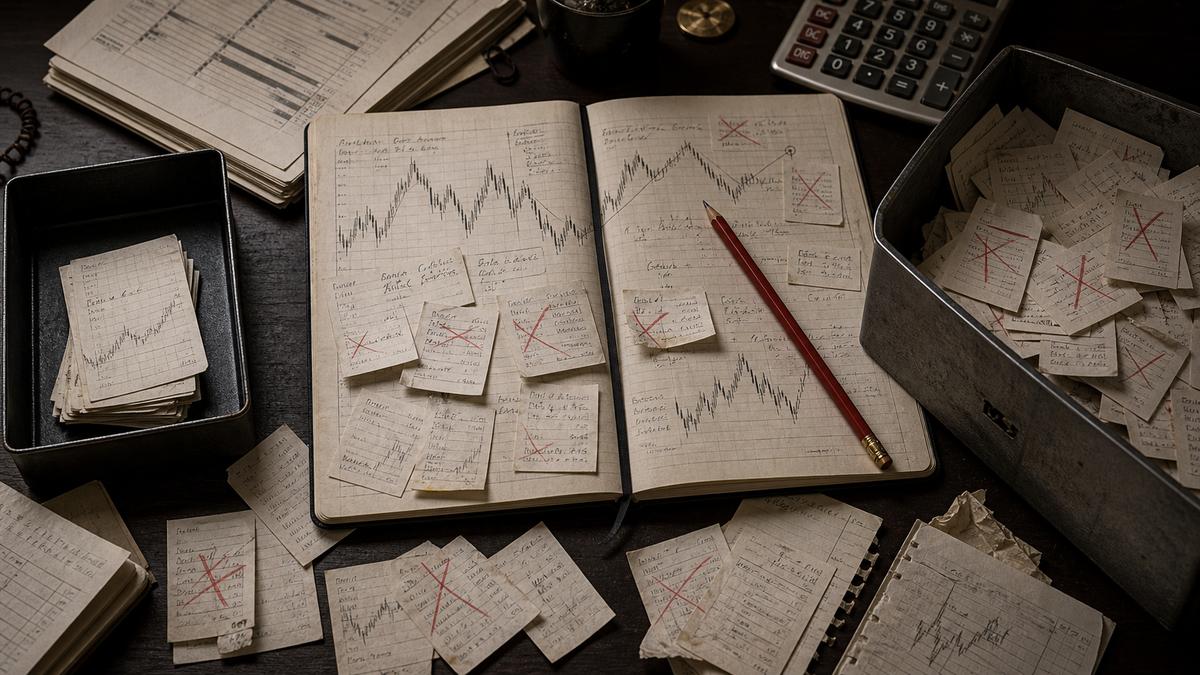
The big number is the least useful part.
Phil Goedeker appears on TraderLion with the kind of headline that always travels: $5,000 into $50 million, parabolic short setup, big wins, big swings.
Fine.
The better lesson is smaller and less comfortable.
Goedeker says that after several profitable years, he looked through his trades and noticed something uncomfortable. The big winners were memorable. He knew the setups. He could remember the stocks, the conditions, the reason for being there.
Then he found the losers.
Not the clean losses. Not the good trades that failed. The forgettable ones. The trades where the chart did not really meet his criteria. The trades taken because he was sitting there, there was not much to do, and something looked "okay" enough to try.
That is the part worth taking back to the desk.
Not the parabolic short.
The garbage pile.
The Account Does Not Only Bleed From Big Mistakes
Most traders know when they did something dramatic.
They remember the oversized position. They remember the revenge trade. They remember the stop they moved. They remember the earnings gamble they should not have touched.
Those trades hurt, but at least they leave a mark.
The quieter damage is harder to catch. A small loss here. A weak setup there. A trade taken during the dead part of the day. A position opened because the trader wanted action, not because the trade demanded it.
None of them looks fatal alone.
Together, they become a tax on the good trades.
Goedeker's review matters because he did not solve the problem by simply getting bigger. He says he considered the obvious path: double position size and maybe profits double with it. Instead, he found another lever. Cut out the weak trades.
That is more interesting than it sounds.
Increasing size can multiply both skill and nonsense. Removing nonsense changes the account before size does.
The Trades You Cannot Remember
One simple test from the interview is brutal.
Can you remember why you took the trade?
Not the ticker. Not the result. The reason.
If a trader looks back and cannot explain why the trade belonged in the book, that trade is probably saying something. Maybe the setup was too loose. Maybe the entry was late. Maybe the stock did not have enough liquidity. Maybe it was the wrong time of day. Maybe the trader was bored.
Boredom is expensive because it disguises itself as opportunity.
The chart only has to be interesting enough to justify a click.
Goedeker describes the weaker trades as excess fat. That phrase works. They are not always catastrophic. They just make the whole operation heavier.
The review is not only "What was my biggest loss?"
It is also: "Which losses had no business being in the sample?"
The Green Immediately Rule
Goedeker also talks about entry in a way that is easy to misunderstand.
He says he almost expects a trade to be green immediately. That does not mean every trade must work from the first tick or it is automatically wrong. Markets are not that polite.
But the standard has teeth.
A good entry should usually reduce argument. If the trade is right, it should start giving feedback. If it is wrong right away, the trader should pay attention instead of explaining.
This matters even more for short selling, where risk can move fast and a trader can get squeezed before the thesis has time to sound intelligent. Goedeker's point is not that a trader should panic out of every wiggle. It is that a trader should not keep feeding a trade that is already giving negative feedback.
No adding to losing trades.
No pretending a bad entry is a better long-term idea.
No turning a tactical trade into a personality test.
The trade either starts behaving, or it has to answer for itself.
Size Down When The Tape Changes
Another practical line from the interview is about drawdowns.
Goedeker says that when he is down, he sizes down. Not after a committee meeting. Not after a long self-help process. If the account is telling him that something is off, he backs up.
That sounds obvious until the trader is actually in the drawdown.
The normal impulse is to make it back. The trader wants to press the next clean setup because it feels like the one that should repair the account. The problem is that the drawdown may be telling him the environment changed, his timing is off, or his own condition is not right.
Goedeker mentions the human side too: sleep, drinking, personal events, whatever changed the trader before the trade changed.
That is not soft psychology. It is risk management.
If the same setup starts performing worse, or the same trader starts executing worse, the first adjustment does not have to be a new system. It can simply be smaller size until the feedback improves.
Good periods earn aggression.
Bad periods earn defense.
A Review That Actually Helps
A trade review does not need to become a software project.
Start with the worst losses.
Then look for the forgettable losses.
Mark each trade by quality, not only by result:
- clean setup, acceptable loss;
- good idea, bad entry;
- correct entry, poor exit;
- too early;
- too late;
- wrong time of day;
- low liquidity;
- boredom trade;
- revenge trade;
- oversized trade;
- trade outside the playbook.
The point is not to create a perfect label system. The point is to see which losses came from the market and which came from the trader forcing something that was not there.
This is where a lot of improvement hides.
The trader may not need a new indicator. He may need fewer trades after lunch. He may need to stop trading names without liquidity. He may need to cut size after two bad executions. He may need to stop taking setups that are almost his setup.
"Almost" can be expensive.
The Desk Version
The desk version:
Before trying to make more, find the trades that should not exist.
Pull the last few hundred trades if you have them. Sort by biggest losses, then by the trades you cannot explain cleanly. Look for repeated leaks. Time of day. Setup quality. Entry chase. Size. Emotional condition. Market condition.
Then write one rule that removes one leak.
Not ten rules.
One.
No trades in the dead zone. No adding to losers. Half size after a 5% drawdown. No setup unless the stock is liquid enough. No entry unless the risk is defined before the order. Whatever the data says.
The lesson from Goedeker is not that everyone should short parabolic stocks. Most traders should probably be very careful around that kind of risk.
The more transferable lesson is duller and more valuable.
You may not have to become more aggressive to improve.
You may have to stop paying for the trades you already know are not good enough.
Disclosure: Margin of Pain publishes research and commentary about traders, markets, and risk. This article is not investment advice or a recommendation to buy, sell, short, or hold any security, derivative, futures contract, currency, commodity, or asset.
Source trail
- TraderLion / YouTube, Trading $5K into $50 Million With the Parabolic Short Setup - Exclusive Interview with Phil Goedeker.
- Listen Notes, Trading $5K into $50 Million With the Parabolic Short Setup - Exclusive Interview with Phil Goedeker.
- Confessions Of A Market Maker, Phil Goedeker Market Wizard The Next Generation.
- Margin of Pain, Mark Minervini and the VCP Setup That Gets Quiet First.
- Margin of Pain, Larry Hite and the Bet Small Enough to Lose.