
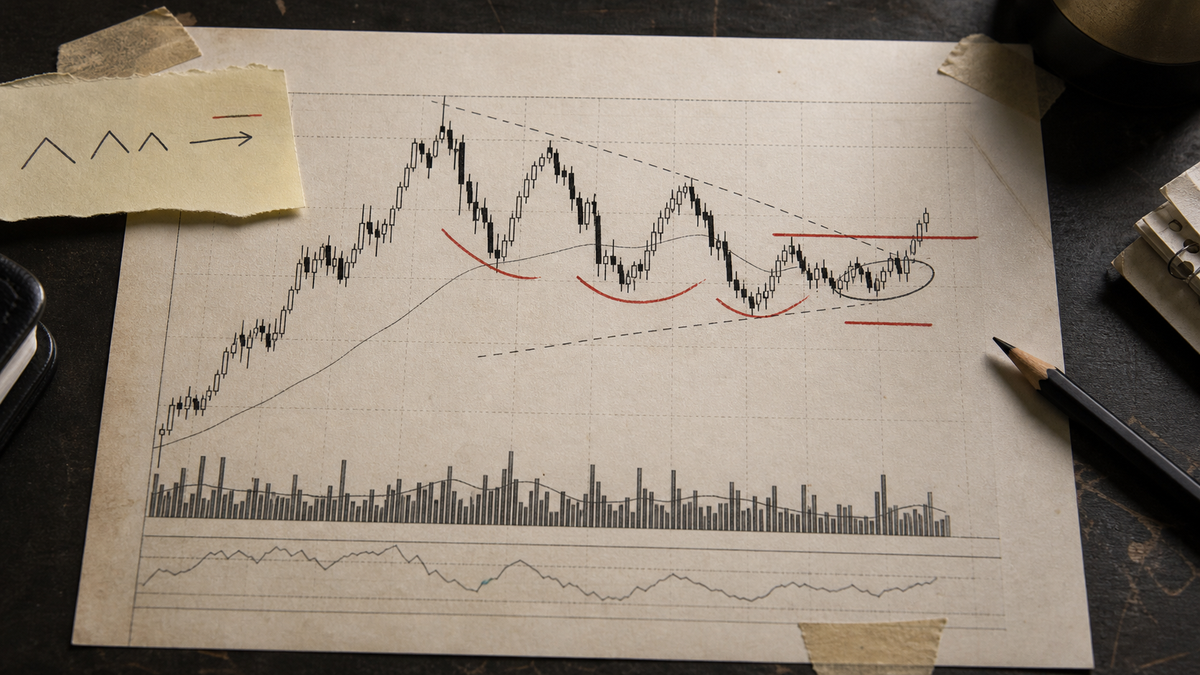
The online version of the Volatility Contraction Pattern is usually too neat.
Three pullbacks. A line across the highs. A breakout arrow. Done.
Mark Minervini's version is more demanding than that. The VCP is not supposed to be a pretty triangle found after the fact. It is a way of watching a strong stock go through a correction, stop acting loose, and give the trader a place where risk can be named before the order goes in.
The setup is famous because it looks simple. A stock advances, pulls back, rallies, pulls back less, rallies again, and then barely gives ground. Volatility contracts. The base tightens. Supply appears to dry up.
That last word matters: appears.
The chart can still fail. The breakout can still reverse. The pattern can still be too obvious, too early, or sitting in the wrong market. The point of the VCP is not to remove risk. It is to compress the trade until the risk is small enough to test.
The chart has to get quiet before it gets interesting.
The Setup Starts Before The Breakout
In a 2024 TraderLion interview, Minervini spends much of the session on what happens during market corrections. That is useful because the VCP is not really a breakout lesson at first. It is a watchlist lesson.
The work starts while the market still looks bad.
Some stocks break with the indexes and need months to repair. Others fall less, recover faster, or move sideways while the broader tape is still soft. Those are the names Minervini wants on the screen.
The distinction is important. A VCP in a laggard is just a tidy shape. A VCP in a leading stock, after a prior advance, while relative strength is holding up, is something else. It says buyers may still be there even though the market has been applying pressure.
The breakout comes late. The earlier question is whether the stock deserves to be watched at all.
That is where a lot of traders jump too quickly. They look for the entry before they know whether the stock is a leader.
What The Pattern Should Show
The mechanical version can fit on one sheet.
First, there is a prior move. Not a random bottom-fish, not a stock down 50 percent that merely stopped falling, but a name that has already shown demand.
Second, there is a correction or base. The stock gives back ground, but it does not lose the whole character of the move.
Third, the pullbacks become smaller. A 20 percent shake becomes 12. Then 6. Then a tight final drift. The exact numbers are less important than the change in behavior. Sellers had room early. Later, they do less damage.
Fourth, volume should quiet down as the range tightens. The trader is looking for less forced selling, not just a stock stuck in place.
Fifth, there is a pivot. Not a mystical level. Just the place where the final tight area would be cleared and the trade can be judged.
Sixth, there is a stop. If the final contraction fails, the trade has to be wrong somewhere.
That is the practical value. The setup is not valuable because it looks clever. It is valuable because it can turn a big idea into a smaller bet.
The Trap Is Buying Too Early
Minervini's examples in the TraderLion discussion include a warning traders should probably hear before the success stories.
A stock can be one of the first names to push toward new highs and still not be ready. It may break out of a short base, find the general market still weak, and come back into the range. That does not automatically kill the idea. It may simply mean the stock needs more time.
This is where a trader can make a good stock into a bad trade.
He sees relative strength. He sees a push toward the old high. He wants to be early. Then the market stays sloppy, the base undercuts, and the stock shakes out the impatient buyer before setting up properly.
The lesson is not "never buy strength." Minervini's whole style is built around buying strong stocks. The lesson is that strength still needs structure.
The better question is simple:
Is the stock ready, or is it only promising?
Those are different entries.
Relative Strength Is The First Filter
Relative strength does not mean the stock has to rise every day while the index falls. Sometimes holding flat is enough. If the market is dropping and the stock refuses to give up much ground, it is already behaving differently.
Still, relative strength is a filter. It is not an entry by itself.
That distinction keeps the setup from turning into chase behavior. A strong relative line puts the stock on the list. The base, contraction, pivot, and stop decide whether a trade exists.
This is also why the market backdrop matters. In the interview, Minervini talks about follow-through days and stocks coming out of bases. The idea is not to buy anything simply because the index bounces. He wants stocks that are already set up, tight, and right-sized when the market gives them room.
The sequence is the edge:
- market under pressure;
- leading stocks hold up;
- relative strength appears;
- bases mature;
- contractions tighten;
- the market improves;
- the breakout has a defined place to work or fail.
The trade comes after the preparation.
The Stop Is Part Of The Pattern
The VCP is often taught from the entry side. The stop is what makes it usable.
Minervini talks about risk first when discussing sells. A tight stop does not force a mechanical sale at a fixed multiple of risk, but it frames the trade. The appeal is getting in with low risk and giving the stock a chance to produce a much larger gain.
That only works if the risk is real.
If the final contraction gives the trader a 3 percent stop, the trade has one character. If the stop has to be 12 percent because the base is still wide, it has another. The chart may still be interesting, but the position is no longer the same.
This is where the VCP can protect a trader from his own excitement. The tighter the setup, the less room there is for argument. If price breaks out and immediately falls back through the pivot, the stock has given information. If it loses the final tight area, the trade has more or less answered the question.
No drama required.
The trade was a test. It failed the test.
A Desk Checklist
The working version of the VCP is not long.
Before considering an entry, the trader can ask:
- Is this stock already a leader, or am I trying to rescue a laggard?
- Did it hold up better than the market during the correction?
- Are the contractions actually getting smaller?
- Is volume drying up, or is the stock still trading loose?
- Is there a clear pivot above the final tight area?
- Can the stop sit near the last contraction without making the trade ridiculous?
- Is the broader market giving breakouts a chance?
- If this fails, will I exit, or will I start explaining?
That last question is not decoration.
Most setup problems become behavior problems after entry. The trader buys something that is almost ready, then manages it as if it were ready. When it shakes out, he widens the stop. When it comes back, he calls it normal base-building. When it finally breaks down, the loss has become larger than the original idea.
The pattern did not fail all at once. The trader stopped respecting the pattern.
What It Does Not Do
The VCP does not predict earnings. It does not know whether the index will roll over tomorrow. It does not make a breakout clean just because the drawing is clean.
It does one narrower thing.
It forces the trader to wait for a strong stock to tighten enough that the entry, pivot, and stop all belong to the same trade.
That is why the setup remains useful even after being over-shared online. Most traders can draw it. Fewer can wait for it. Fewer still can take the loss when the final contraction fails.
There is no magic in the acronym.
The useful part is the order: strength first, base second, contraction third, risk last, then entry.
Minervini's VCP is not a promise that the stock will go.
It is a way to avoid buying before the trade has become small enough to be wrong.
Disclosure: Margin of Pain publishes research and commentary about traders, markets, and risk. This article is not investment advice or a recommendation to buy, sell, short, or hold any security, derivative, futures contract, currency, commodity, or asset.
Source trail
- TraderLion / YouTube, The Perfect VCP Trading Setup with Mark Minervini.
- Mark Minervini, Trade Like a Stock Market Wizard.
- Mark Minervini, Think & Trade Like a Champion.
- Minervini Markets 360, official site.
- Jack D. Schwager, Stock Market Wizards.
- William J. O'Neil, How to Make Money in Stocks.
- Margin of Pain, Peter Brandt and the Position That Is Not an Opinion.
- Margin of Pain, Larry Hite and the Bet Small Enough to Lose.