
Peter Brandt is known for charts.
That label can be misleading.
The most interesting part of his FundSeeder interview is not a pattern, a breakout, or a market call. It is a drawdown.
Brandt describes 2013 as the worst year of his later trading career. He says he bought into the idea that the markets had changed and that what used to work no longer worked. So he started experimenting. More indicators. Different inputs. New trails to follow.
The drawdown, in his telling, got worse.
It is a better story than another chart lesson because it gets to the part traders actually face. The market stops paying them, and suddenly the old method looks dead.
Maybe it is dead.
Maybe the trader is panicking in a professional-sounding way.
Brandt eventually says peers pushed him back toward his basics. Go back to what you do. If it does not work, quit and do something else. But stop wandering.
Brandt is known for classical charting. But the subject here is not chart worship.
It is the line between an opinion and a position.
Brandt says he can be bullish one week, bearish the next, and fine with the switch. His opinion is not necessarily his position. His position is not necessarily his opinion.
Most traders blur that distinction the moment money is involved.
They see something. They form a view. Then they start defending the view as if the market owes them consistency.
Brandt's version is colder. A chart is not there to make him loyal to an opinion. It is there to show whether there is an asymmetrical reward-to-risk opportunity worth taking.
The Chart Is A Measuring Tool
Classical charting can easily become theatre.
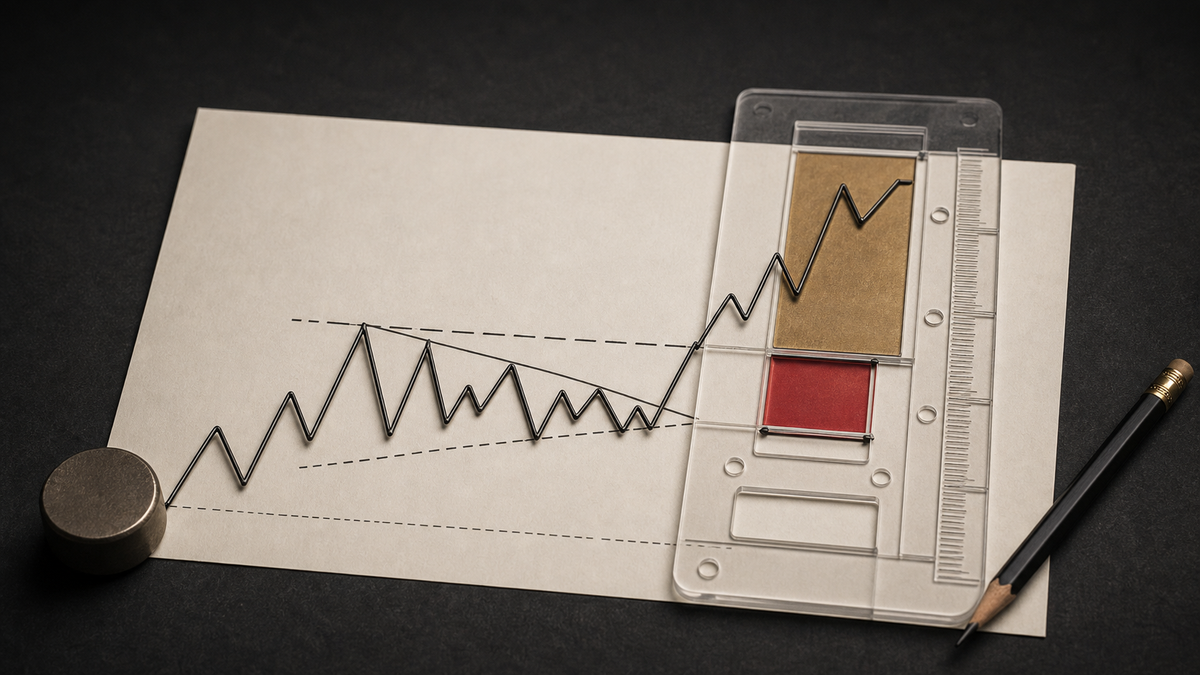
A trader draws a triangle, a rectangle, a head-and-shoulders, a breakout line. The pattern looks clean. The story looks clean. The trader begins to feel that the market has said something.
Brandt pulls that back toward work.
He says, in effect, that the chart should tell him where risk and reward are stacked enough to put money at risk. The chart is not a prophecy machine. It is a measuring tool.
That changes the job.
The question is not "What do I think this market should do?"
The question is "Where am I wrong, what can I lose, and is the upside worth the attempt?"
Less exciting than prediction. More tradable.
The Drawdown That Asked Him To Become Someone Else
The 2013 section shows how a drawdown changes the questions in the trader's head.
At first, it starts as a losing streak. Then the explanation arrives.
Maybe the market structure changed. Maybe classical charting needs help. Maybe the system needs filters. Maybe the trader has to become more macro. Maybe another layer of data will stop the bleeding.
Some of those may be good questions in the right setting. Markets change. Traders should adapt. Brandt says he has changed over time.
But timing matters.
Changing process in the middle of pain is different from improving process from a stable base. In the middle of a drawdown, the trader may not be researching. He may be trying to escape the feeling of being wrong.
There is the trap.
The drawdown does not only take money. It offers the trader a new identity.
Sharper than "stick to your plan": know what your plan is well enough that a losing streak does not get to rewrite who you are.
The Career Choice
Brandt gives another reason he has lasted: he wanted trading to be a career.
Not a month. Not a big year. Not a fast run.
A career.
That sounds obvious until you look at how many traders behave. They do not size like people trying to be around in ten years. They size like people trying to make the next screenshot worth posting.
Brandt says a mentor pushed risk management into him early. The lesson was basic and hard: once the money is gone, the game is over. Survive today so there is capital tomorrow.
The exact method changes. The survival rule does not.
The professional trader is not the one with the strongest opinion. The professional is the one who still has money and process after the opinion fails.
AI Does Not Take The Loss
Brandt's AI point is refreshingly plain.
He says he used AI to build arguments for why the dollar could be stronger against the euro in 2026, and arguments for why it could be weaker. Both sides were useful. Neither side traded the account.
The trader still has to push the button. The trader still has to choose size. The trader still has to manage the position. The trader still has to take the loss.
That is where the responsibility sits.
AI can produce arguments. It can surface scenarios. It can organize information. But it cannot turn a view into a trade without someone accepting risk.
For Brandt, the chart still has a job because price still has to discover itself. There will be trends. There will be chop. There will be signals that work and signals that fail.
The tool changes.
The loss still belongs to the trader.
The Office Is Supposed To Be Boring
Brandt tells a small story about Jack Schwager describing the offices of Market Wizards.
Not shouting. Not spectacle. More like an insurance company.
Closer to the truth than the public image of trading. The actual work is not someone screaming at screens. It is a process repeated enough times that it becomes ordinary.
Orders. Risk. Stops. Review. Capital. Repeat.
That does not mean trading is easy. It means the work has to become routine enough to survive stress.
A trader cannot borrow someone else's process when the drawdown arrives. He might copy the entries during a winning streak. The problem comes when the system hits the skids.
At that point, the trader has to own the process.
If he does not understand why he trades the way he trades, the first serious losing streak will make another method look better.
The Desk Version
The desk version is direct.
Do not ask only what the chart means.
Ask what the chart lets you risk.
Before taking a trade, the trader should know:
- what pattern or setup is actually present;
- where the trade is wrong;
- what the reward-to-risk looks like;
- what size keeps the loss ordinary;
- whether the trade is a position or just an opinion with money attached.
During a drawdown, the trader should ask a different set of questions:
- am I changing process because I have new evidence;
- am I changing process because losing feels bad;
- do I still understand why this method should work over time;
- what would prove that the method is broken rather than temporarily out of sync.
That last question is hard and necessary.
Brandt's interview works because it does not sell charting as certainty. The chart does not know the future. It does not remove risk. It does not make a trader right.
At its best, it gives the trader a place to measure the bet.
The position is not the opinion.
The position is the risk the trader is willing to carry after the opinion has been tested against a plan.
Disclosure: Margin of Pain publishes research and commentary about traders, markets, and risk. This article is not investment advice or a recommendation to buy, sell, short, or hold any security, derivative, futures contract, currency, commodity, or asset.
Source trail
- FundSeeder / YouTube, Peter Brandt on Risk, Discipline & Survival in Markets for 40+ years.
- Peter Brandt / Factor Trading, The Four Key Pillars of Factor.
- Peter Brandt / Factor Trading, About Peter L. Brandt.
- Peter L. Brandt, Diary of a Professional Commodity Trader.
- Jack D. Schwager, Unknown Market Wizards.
- Margin of Pain, Larry Hite and the Bet Small Enough to Lose.
- Margin of Pain, Tom Basso and the Trade That Lets You Breathe.