
Elon Musk's space data center idea is the noisy part.
Put AI in orbit. Use solar power without clouds, night, land fights, or local grid delays. Launch enough hardware and the cheapest place to run compute may eventually be above Earth, not on it.
Maybe it happens. Maybe it stays a useful provocation.
The market point is closer to the ground.
In a long interview with Dwarkesh Patel, Musk keeps returning to one blunt problem: the chips are arriving faster than the electricity. GPUs can be bought, ordered, financed, fought over, and improved. But a data center still has to be powered, cooled, connected, permitted, and kept online.
Here the AI trade starts to change shape.
Not away from chips. The chips still matter.
But the next question is less glamorous: who can turn them on?
The Chip Is Not The Whole Trade
The clean version of the AI story is easy to understand.
More models need more compute. More compute needs more GPUs. More GPUs mean more revenue for the companies that sell chips, networking, memory, and data center gear.
That version has worked, and may keep working.
But it leaves out the part that is harder to scale quickly: the physical plant around the chip.
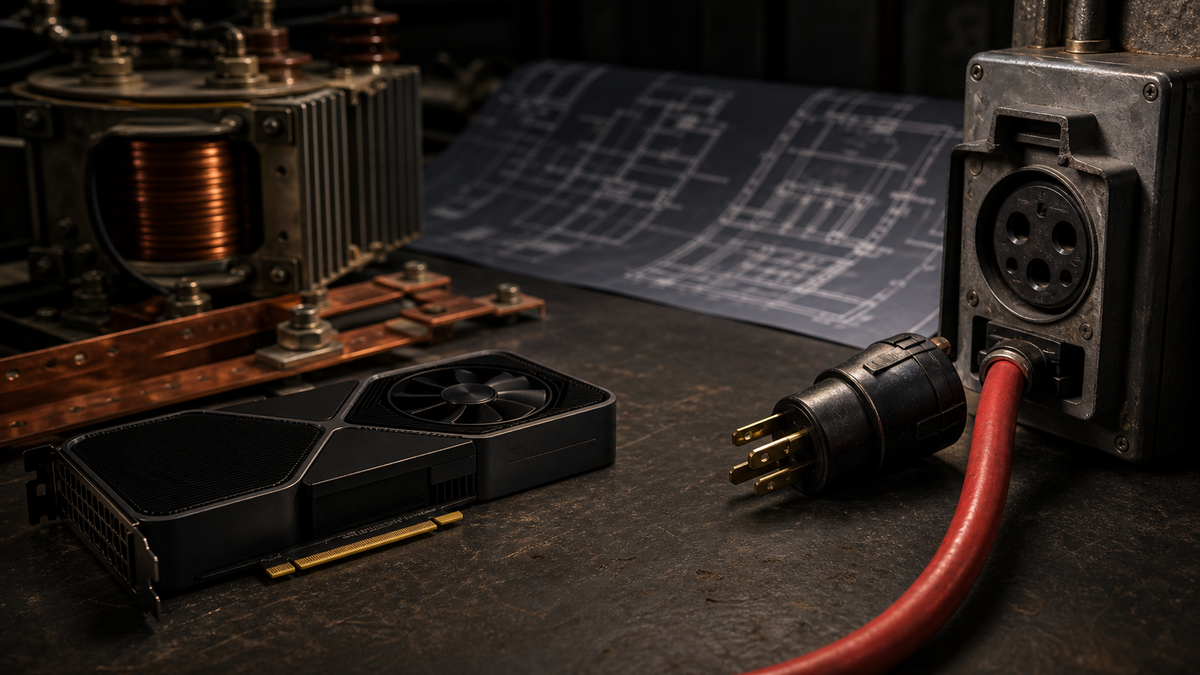
A GPU in a warehouse is not compute. A GPU connected to power, cooling, networking, software, backup systems, and enough grid capacity is compute. The difference sounds boring until it becomes the bottleneck.
Musk's argument is that power will increasingly decide how much AI can actually be used. In the interview, he pushes back against the idea that energy is a small piece of total data center cost. The chip may be the expensive object. It still needs a plug.
The point is not that Musk has the final answer.
It is that he names the constraint.
The Wall Socket Problem
Data centers are not new. Power problems are not new either.
What is new is the speed at which AI wants to add load.
The International Energy Agency has been warning that electricity demand from data centers is rising quickly, with AI becoming a larger driver. The details vary by country and forecast, but the direction is not subtle. More large data centers mean more pressure on grids, substations, transmission lines, transformers, cooling systems, and local permitting.
This is the plain machinery behind the headline.
A company can announce an AI cluster. It can order GPUs. It can sign a cloud deal. It can raise capital. Then the project still has to get enough power to one location.
Call it the wall socket problem.
Investors like to talk about model capability. Operators have to talk about interconnect queues, gas turbines, solar farms, batteries, water, cooling, and backup generation.
The stock market prefers the model conversation.
The buildout eventually drags everyone into the other one.
Why Musk Talks About Space
The space data center part sounds absurd at first pass, which is why it works as a test.
There are obvious objections. Hardware in orbit is harder to service. Launches are expensive. Radiation is not friendly to electronics. Cooling is not free just because the Sun is free. Latency matters for some workloads. Chips improve quickly, and expensive hardware sent into space can become old hardware before the capital cycle feels comfortable.
Those objections are real.
Musk's reply is scale. His case is that space solar avoids night, weather, seasonal variation, land constraints, and batteries. If launch cost falls far enough, he argues, space becomes a place where energy can scale faster than ground infrastructure.
The argument can be wrong and still tell investors something.
It shows what Musk thinks the limiting variable is.
Not model architecture. Not only chip supply. Not only talent.
Power.
The orbit idea is the extreme version of a terrestrial problem. If it is painful to build enough data centers and power plants on the ground, a vertically integrated space company starts asking whether the ground is the bottleneck.
None of this makes orbital AI a near-term base case.
It does make the power constraint harder to wave away.
What To Watch On Earth
A trader does not need to bet on AI satellites to follow the story.
The near-term version is already on Earth.
Watch where the bottlenecks show up:
- data center power availability;
- grid connection delays;
- transformer and switchgear lead times;
- gas turbine demand;
- utility capital spending;
- behind-the-meter generation;
- battery storage economics;
- cooling requirements;
- local pushback on water, noise, land, and power use.
None of these are clean trades by themselves. That is how a good theme still hurts people.
Utilities are regulated. Equipment makers can be cyclical. Data center landlords can overbuild. Power producers can be hurt by fuel costs, politics, and capital intensity. Solar and battery economics can improve while individual companies still disappoint.
The theme can be right while the trade is messy.
The Risk Of A Simple Story
The AI power thesis has its own trap.
Once investors decide that electricity is the bottleneck, every grid-adjacent stock can start pretending to be an AI stock. That is usually when discipline matters.
There is a difference between a company that benefits from real demand and a company that merely stands close enough to the story to borrow the multiple.
The questions are basic:
- Does the company sell into actual data center buildouts?
- Is demand showing up in backlog, contracts, pricing, or capex plans?
- Can margins hold if everyone chases the same theme?
- Is the project waiting on permits, equipment, fuel, or transmission?
- Is the stock already priced as if the bottleneck has been solved in its favor?
Markets like to flatten these things.
AI needs power. Buy power.
Not enough.
The hard work is finding where the bottleneck creates revenue, where it creates cost, and where it creates a press release.
Those are three different things.
The Desk Version
The desk version:
If AI demand keeps rising, the question shifts from "Who has the best chip?" to "Who can deploy useful compute at scale?"
That means chips, yes.
But also land, power, cooling, networks, substations, transformers, turbines, batteries, contracts, and time.
Musk's space data center prediction may prove too early, too expensive, or simply wrong. That would not kill the more important observation. The AI buildout is becoming a physical infrastructure story, not just a software story with expensive processors attached.
The chip is still the object everyone wants to look at.
The wall socket may be where the trade gets harder.
Disclosure: Margin of Pain publishes research and commentary about traders, markets, and risk. This article is not investment advice or a recommendation to buy, sell, short, or hold any security, derivative, futures contract, currency, commodity, or asset.
Source trail
- Dwarkesh Podcast, Elon Musk: In 36 months, the cheapest place to put AI will be space.
- YouTube mirror used for transcript review, Elon Musk latest interview (AI, Robots, Space Data Center, DOGE).
- International Energy Agency, Energy and AI.
- International Energy Agency, Data centres and data transmission networks.
- Goldman Sachs, AI is poised to drive 160% increase in data center power demand.
- Margin of Pain, Mark Minervini and the VCP Setup That Gets Quiet First.