
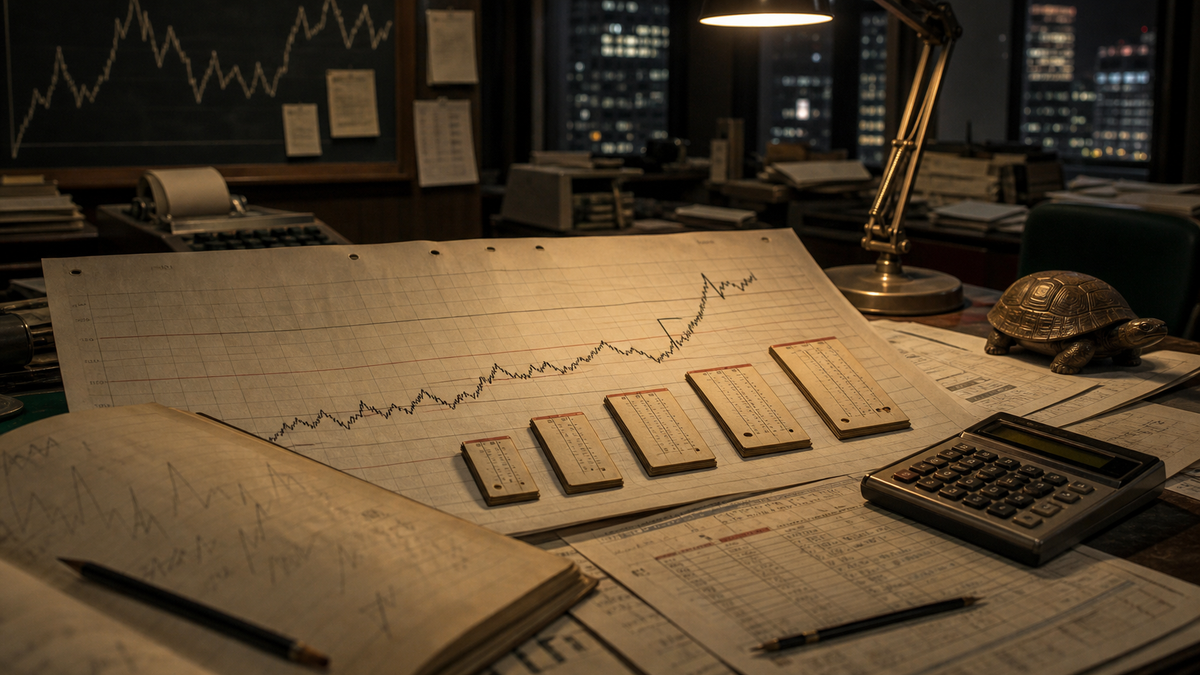
The lazy version of the Turtle story is simple enough to sell.
Buy the 20-day high. Sell the 20-day low. Follow the trend. Get rich because Richard Dennis proved trading could be taught.
That version is too clean, and the clean version is where traders get hurt.
The Turtle experiment became famous because Dennis and William Eckhardt took a group of trainees in the early 1980s and taught them a systematic way to trade futures. The public argument was partly about talent. Dennis believed traders could be trained. Eckhardt was more skeptical. The result became one of the great market stories because the rules were plain enough that people could imagine copying them.
A breakout entry is the part everybody remembers, and the least useful part to copy by itself.
An entry is not a trading system. The Turtle method had the rest of the building around it: what markets to trade, how much to buy, when to add, where to exit, how to handle volatility, and how to keep taking signals after a run of false starts.
Without those pieces, the famous rule becomes a way to chase highs with too much size.
The Breakout Was Supposed To Be Dumb
There is nothing intellectually fancy about buying a new high.
That was part of the point. A breakout can be defined before the trade. It does not require the trader to read a central banker's face, guess next quarter's earnings, or decide whether a chart "looks strong." Price has either broken the level or it has not.
The Turtles used breakout systems that have been described publicly for years: a faster system built around 20-day breakouts and a slower one around 55-day breakouts. A long signal came when price made a new high over the chosen lookback. A short signal came when price made a new low.
It sounds almost childishly simple. It is also why it can be tested.
The rule does not ask whether the trader feels bullish. It does not care whether the move looks extended. It does not wait for the perfect newspaper explanation. Trend following starts from an uncomfortable admission: if a market is moving, the market may know something before the trader does.
That does not mean the entry is magic. Most breakouts are not the beginning of historic trends. Many are ordinary noise. Some are traps. Some reverse immediately. A breakout system pays for the right to catch the big move by accepting a lot of bad-looking little trades.
That is the bill. The real Turtle lesson is not that breakouts work. It is that a trader needs a structure that can keep paying that bill without losing his mind or his account.
Volatility Decided The Size
The most important Turtle rule was not where to enter. It was how large the position could be.
The rules used a volatility measure called N, usually described as a version of average true range. A quiet market received a larger position. A violent market received a smaller one. The goal was not to make every market feel exciting. The goal was to make risk more comparable across contracts.
That is a completely different way of thinking from most retail trading.
Retail traders usually start with the thing they want to trade. Crude oil looks active. Gold is moving. Nasdaq futures are hot. Bitcoin is alive. Then they pick a size that feels normal for the account, often because the platform makes the number easy to click.
The Turtle approach starts with the market's movement. If the market moves a lot, the size comes down. If it moves less, the size can rise. The contract does not get more room because the trader is excited. The trader gets less size because the contract is wild.
Two trades can look similar on a chart and carry very different dollar risk. A two-point move in one product is not the same as a two-point move in another. A one-contract position can be tiny in one market and absurd in another. The account does not care that the chart looked clean. It cares what the move costs.
Volatility sizing forces the trader to ask the ugly question before entry:
if this normal move happens against me, what is the damage?
The Stop Was Part Of The Math
The Turtles did not treat the stop as a mood.
Public descriptions of the rules usually put the stop at a multiple of N from entry or from the last added unit. The exact historical formula is less important for a modern trader than the habit behind it: stop distance was connected to volatility, and position size was connected to stop distance.
A trader who buys a breakout in a quiet product can use a smaller dollar stop than a trader buying a breakout in a violent product. If both traders use the same contract size because they both "like the setup," one of them is not managing risk. He is pretending the chart scale does not matter.
This connects directly to the stop-loss problem.
If the correct stop is too far away for the account, the answer is not to drag the stop closer. The answer is to trade smaller, find another instrument, or skip the trade. The Turtle method was built around that mechanical discomfort. It did not ask the trader to feel brave. It reduced the decision to units.
This is why the rulebook matters more than the entry. The entry tells the trader when to get involved. The sizing rule tells him whether he is allowed to survive being wrong.
Adding Was Also A Rule
The Turtles are often associated with pyramiding: adding to a position as it moves in the right direction.
That sounds aggressive because it is. But in the system, adding was not the same thing as getting excited. The adds were rule-based. They were made at defined intervals, tied to volatility, and limited by exposure rules.
This is another point retail traders often invert.
They add because the trade feels good. They add because they are finally right. They add because unrealized profit feels like house money. Then a normal pullback turns a winning trade into a confused one.
The Turtle idea was colder. If the market moved enough in the trade's favor, the system could add. If it did not, it could not. The add was not a celebration. It was another trade inside the same structure.
Trend following needs the rare large winner to matter. Small winners are not enough if the system takes repeated small losses. So the trader has to be there when the move expands. He also has to accept that adding late in a trend will sometimes make the giveback hurt.
There is no clean way around that. The system tries to make the tradeoff explicit. It does not promise comfort.
The Boring Part Was The Edge
The Turtle rules are attractive because they look mechanical.
Mechanical does not mean easy.
The hard part is not understanding a 20-day high. The hard part is taking the next signal after the last three failed. The hard part is cutting a position that looked brilliant yesterday. The hard part is watching a market run without you because the rule said the last signal disqualified the next one. The hard part is trading smaller during a drawdown without deciding the system is broken.
This is where the experiment still matters. The rules were designed to remove certain decisions from the trader. That does not remove pain. It changes where the pain sits. Instead of pain from guessing, there is pain from obeying. Instead of "what do I think?" the question becomes "will I do what I said I would do?"
Most traders prefer the first pain because it feels creative.
The second pain is duller and more revealing.
If a trader cannot follow a simple rule when it is losing, he probably cannot follow a complicated one either. Complexity often hides the same old problem: the trader wants a system that gives orders, until the orders are unpleasant.
What A Trader Can Steal
The modern trader does not need to recreate the Turtle system.
Markets are different. Costs are different. Futures access is different. Information moves faster. Trend following is no longer a strange secret. A 20-day breakout by itself is not a private edge.
But several habits still travel well.
First, define the trade before the trade. Entry, stop, exit, add rules, and invalidation should not be invented after the position is red.
Second, size by volatility. If a product moves twice as much, the position should not be the same size just because the chart is on the same screen.
Third, let the system include losses. A method that only looks good when the last signal worked is not a method. It is a recap.
Fourth, decide what kind of pain the strategy creates. Trend following creates whipsaws, late entries, givebacks, and long stretches of looking stupid. Mean reversion creates different pain. Day trading creates different pain. No strategy removes pain. It only chooses the shape.
That is the real Turtle lesson. The famous breakout was not a magic line. It was one rule inside a machine built to survive being wrong often enough to be there when the rare trend paid.
Most traders copy the line.
The money was in the machine.
Disclosure: Margin of Pain publishes research and commentary about traders, markets, and risk. This article is not investment advice or a recommendation to buy, sell, short, or hold any security, derivative, futures contract, currency, commodity, or asset.
Source trail
- TurtleTrader, The Original Turtle Trading Rules — Taught by Richard Dennis in 1983.
- TurtleTrader, Richard Dennis profile.
- Stockopedia, Turtle Trading Rules: Trend Following Investing Based On 20 & 55 Day Highs.
- Jack D. Schwager, Market Wizards, chapter on Richard Dennis.
- Curtis Faith, Way of the Turtle.
- CFTC, Futures Market Basics.
- NFA, Investor Best Practices.