
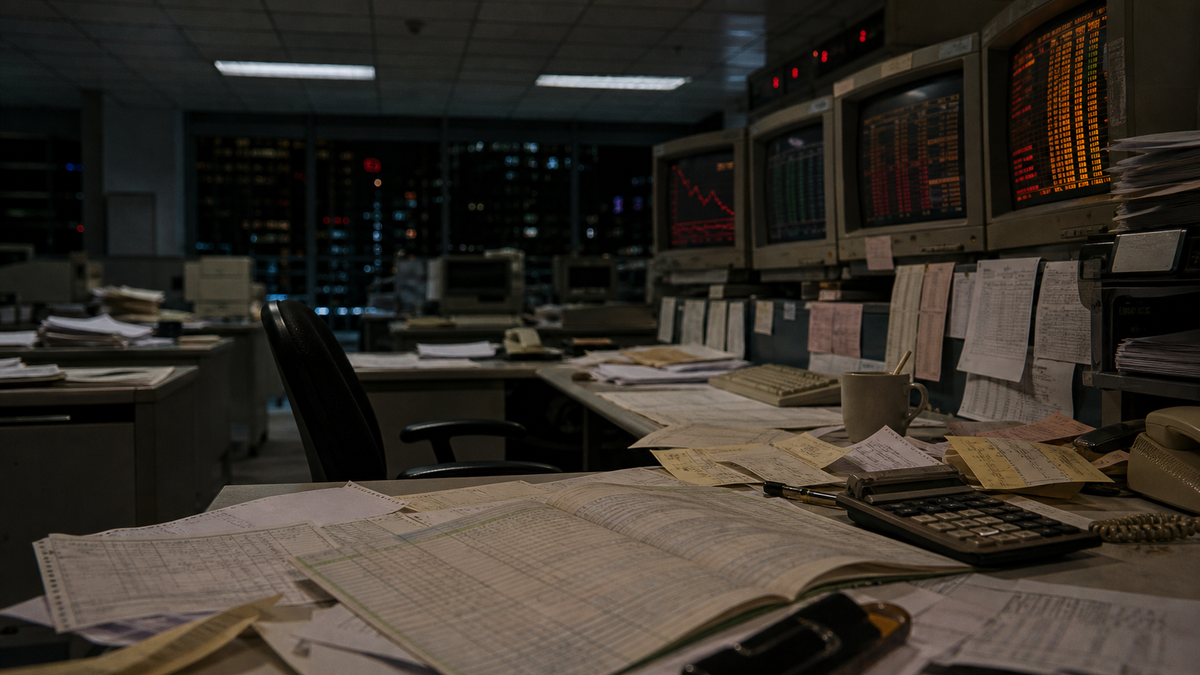
Barings did not die in one trade.
The usual Nick Leeson story tends to miss the slow part. It did not begin with a single mad position, a sudden earthquake, and a trader pressing the wrong button in Singapore. A loss was hidden. Another loss had to be hidden behind it. Eventually the book was large enough that telling the truth would have destroyed the trader, the desk, and perhaps the people who had believed the desk.
By the time Barings collapsed in February 1995, the market position was only one side of the problem. The other side was the record.
Leeson was 28 years old. Barings was more than two centuries old. The bank had survived wars, panics, defaults, and the normal humiliations of finance. It did not survive a Singapore futures operation that appeared to be making unusually good money from supposedly low-risk arbitrage.
That appearance mattered. Profits can be very persuasive when nobody wants the job of asking where they came from.
Singapore was both the trade and the paperwork
Leeson arrived in Singapore in 1992. According to Singapore's National Library Board, he became Derivatives Operations Manager at Barings Futures Singapore by the end of May that year, passed the relevant SIMEX exams, received a trading licence, and later became assistant director and general manager.
The arrangement behind the title mattered more than the title itself. Leeson was effectively both chief trader and head of settlements.
That should have been impossible.
In a normal trading firm, the front office takes the risk and the back office records it. The split is not glamorous. It is not meant to be. It exists because traders have incentives, and incentives are not internal controls. The person who can make the trade should not also be the person who can bury the trade.
At Barings Futures Singapore, that line was not hard enough. The Reserve Bank of Australia's summary of the official British inquiry says Leeson effectively controlled both dealing and back-office functions. That gave him room to trade without authority, alter transaction details, and hide losses from management.
No derivative model was needed to see the problem. The fuse was administrative.
The account number became famous for a reason
Account 88888 is the object everyone remembers.
It was described as an error account: a place to park mistakes, wrong bookings, and small discrepancies while the office sorted them out. Every trading operation needs plumbing like this. Healthy plumbing is temporary, visible, and boring.
In Singapore, 88888 became useful for the wrong reason.
The National Library Board's account says the account was used to hide Leeson's losses and unauthorized trades, even though it was thought to track real trading errors and minor accounting discrepancies. The scandal sits in that conversion: a control account became a blind spot.
The number itself has become almost too theatrical. Five eights. Easy to remember. Perfect for headlines. The more useful question is not whether Leeson had a secret account. It is why the surrounding firm kept sending money into a business whose reported profits and funding needs should have been read together.
Good profits plus heavy funding is not automatically fraud. It is, however, a question.
Barings did not ask it hard enough.
The official business was supposed to be dull
The business London thought it had in Singapore was largely arbitrage, often described as switching between Singapore and Osaka. In clean form, that means exploiting small price differences between related Nikkei futures contracts on different exchanges. Buy one side, sell the other, capture the spread, keep the net market exposure small.
It is the version that sounds respectable in a committee meeting.
The actual book was not that.
The RBA summary says Leeson had been taking unauthorized positions for roughly two and a half years in Nikkei futures and Japanese Government Bond futures on SIMEX and Osaka. It also says he wrote exchange-traded options on the Nikkei Index, exposing Barings capital to potentially unlimited loss.
By early 1995, the shape was plain enough: long Nikkei futures, short Japanese Government Bond futures, short Nikkei options. The book wanted the Nikkei to rise, Japanese bond prices to fall, and volatility to remain manageable.
That was not arbitrage. It was a market view with leverage.
The difference is not academic. Arbitrage is sold internally as small margins, operational competence, and high volume. Directional trading with short options is a different animal. It can make money for a while and still be waiting for one adverse move to expose the whole construction.
In Barings' case, the construction was also hidden from the people funding it.
Kobe exposed what was already there
The Kobe earthquake hit Japan on January 17, 1995. It is often treated as the moment that destroyed Barings.
It was the visible shock, not the original disease.
The Nikkei fell after Kobe. Volatility rose. A book that needed a stable or rising Japanese market became harder to defend. The Singapore account says Leeson increased the size of the bets after the earthquake as losses escalated.
But the losses were not born in January.
The RBA summary says cumulative unrecognized losses were already over GBP 200 million at the end of December 1994. By February 27, 1995, unreported losses had reached GBP 827 million. After the positions were closed, cumulative losses from the unauthorized trading came to GBP 927 million.
Those numbers make the earthquake explanation too clean. Kobe did not create the hidden book. It forced the hidden book into daylight.
Markets do this often. They are very good at arriving after everyone has had enough time to build the fragile thing.
The money kept moving
One of the stranger parts of the Barings case is not the loss itself. It is the funding.
The official inquiry, summarized by the RBA, found that Leeson's activities required high levels of funding from London. The demands increased sharply before the collapse. At the same time, the Singapore office seemed to be producing exceptional profits from low-risk business.
That combination deserved suspicion.
Instead, Barings treated Singapore as a major contributor. The RBA summary says management recognized that more than 60 percent of the worldwide derivatives operation's revenues were coming from Leeson's arbitrage activities.
There is a nasty little incentive problem inside that sentence. A profit center that large is not easy to challenge. The person asking questions risks looking slow, political, or jealous. If the answer turns out to be innocent, he has made himself unpopular. If the answer turns out to be bad, he has exposed a failure that may already be too large for anyone nearby to admit.
So the profitable mystery gets one more week.
Then another.
The phrase "rogue trader" is too convenient
Leeson concealed losses and unauthorized trading. He later served prison time in Singapore. None of that should be blurred.
But "rogue trader" can become a laundering phrase for institutions. It turns a control failure into a character study. The villain is removed from the building, and the building gets to call itself unlucky.
The official British inquiry was harder on Barings than that. The RBA summary describes a virtual total failure of risk management systems and controls, along with managerial confusion inside the group. It points to weak separation of duties, unclear responsibility, failure to question extraordinary profits, inadequate independent risk management, and slow action on internal audit warnings.
This is not a footnote. It is the story.
The trader did the hiding. The institution made hiding possible.
The trade after the trade
There is a point in losing where the next position stops being a new decision.
It becomes a repair attempt.
This is where the Leeson case becomes useful for traders who will never work in a bank. The public version is huge: old merchant bank, Singapore futures, account 88888, nearly a billion pounds lost. The private version is smaller and more common.
A trader moves a stop because the loss feels too stupid to accept. He adds size because the average entry now looks less embarrassing. He tells himself the market only has to come back a little. He stops writing down the thesis because the thesis has become a negotiation with the account statement.
This is not Barings. It is not criminal. But it is the same direction of travel.
The first loss is financial. The second loss is informational. Once the record is no longer honest, the trader has to manage two books: the market book and the story about the market book.
The second one is usually more expensive.
What Barings actually teaches
Barings is remembered as a derivatives disaster, but that is only partly right. The instruments mattered. Nikkei futures, JGB futures, and short options gave Leeson enough leverage to create a catastrophic exposure. But the more basic failure was that nobody with power had a reliable picture of the exposure.
Risk cannot be managed if the record is false.
That sounds obvious, which is why people underrate it. Finance likes sophisticated explanations. Sometimes the simple one is the one that actually bit.
Separate the trader from the paperwork. Reconcile independently. Treat unexplained profits as questions, not trophies. Watch funding demands. Take internal audit seriously before the public gets to read the autopsy.
For an individual trader, the same idea is less procedural and more uncomfortable: keep the record clean. The trade you hide from your own journal is the one that starts making decisions for you.
Nick Leeson did not just bet wrong on Japan. He kept a losing reality away from the official reality until the gap needed more cash than Barings could provide.
Account 88888 still matters because it names the place where the trade stopped being a trade and became a cover story.
Disclosure: Margin of Pain publishes research and commentary about traders, markets, and risk. This article is not investment advice or a recommendation to buy, sell, short, or hold any security, derivative, futures contract, currency, commodity, or asset.
Source trail
- GOV.UK / Board of Banking Supervision, Report into the collapse of Barings Bank, published July 18, 1995.
- Reserve Bank of Australia, Implications of the Barings Collapse for Bank Supervisors, Bulletin, November 1995.
- National Library Board Singapore, Barings Bank collapses from Nick Leeson's losses.
- National Library Board Singapore catalogue entry, Baring Futures (Singapore) Pte Ltd: investigation pursuant to Section 231 of the Companies Act, Ministry of Finance, 1995.
- Encyclopaedia Britannica, Bankruptcy of Barings Bank.