
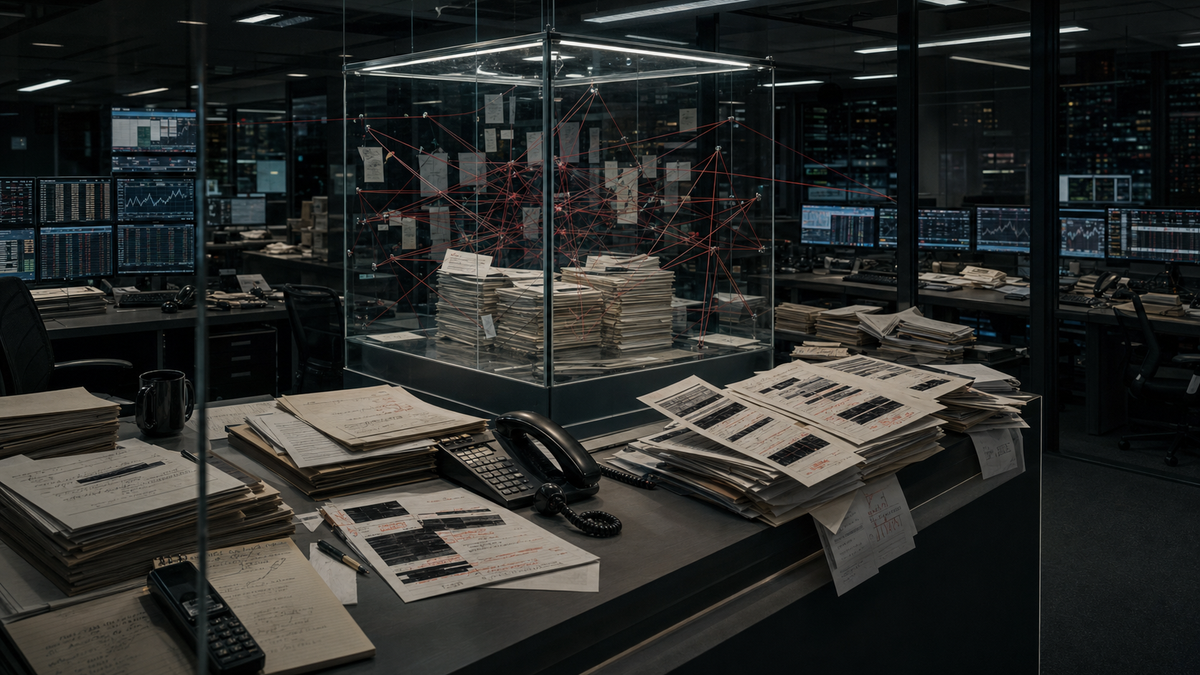
The position did not announce itself.
Archegos Capital Management was not a hedge fund in the normal public imagination. It did not publish a big investor letter. It did not need to explain itself on CNBC. It was a family office, run by Bill Hwang, and its largest bets sat behind contracts with banks.
That mattered.
When Archegos collapsed in March 2021, the shock was not only the size of the losses. It was the way the size had been hidden in plain sight. Each bank could see its own exposure. No bank could see the full crowd standing in the same room.
The instrument was the total return swap.
In a total return swap, the client can receive the economic return of a stock without buying the stock directly in the ordinary way. The bank buys or hedges the exposure, the client posts margin, and the position can grow without the same public ownership trail that a cash stock position would usually leave.
On the desk, the result was plainer: Archegos could build enormous exposure to a handful of stocks while the market saw much less than the real trade.
The Securities and Exchange Commission later said the firm's exposure grew from roughly $10 billion to more than $160 billion in about one year. The value of Hwang's portfolio, according to the SEC, rose from about $1.5 billion to more than $35 billion before the collapse.
Those are not normal family-office numbers. They are numbers from a machine that had found room between disclosure, leverage, and bank competition.
The Same Names At Different Banks
Archegos did not need hundreds of ideas.
The book was concentrated in a small group of media, technology, and Chinese internet stocks. ViacomCBS became the name most people remember because its move was violent and visible. Discovery, Baidu, Tencent Music, Vipshop, and others were part of the same story.
The public could see the share prices rising. What it could not see was the private leverage behind them.
One bank might see a client with a large swap exposure. Another bank might see the same thing. A third might see another piece. None of those views automatically produced a single picture of Archegos' total risk.
There was no magic in it. Old market plumbing did what old market plumbing often does. Every desk had a reason to keep the relationship. Every desk had models, margin terms, and risk reports. Every desk also had competitors.
The trade grew inside that gap.
The CFTC later alleged that Archegos made misleading statements to its swap counterparties and that the firm's portfolio became wildly concentrated. According to the agency, Archegos at one point held a largest position equal to roughly 70 percent of its net asset value while representing to counterparties that the number was about 35 percent.
The spread between those two numbers is not a detail.
If a bank thinks a client has a large position, it may ask for more margin. If it thinks the position is one piece of a broader, less concentrated book, it may treat the risk differently. Archegos' counterparties were not just financing a trade. They were financing a picture of the trade.
The picture was wrong.
ViacomCBS Cracked First
In March 2021, ViacomCBS raised new capital through a stock offering. The share price had already run hard. The offering hit the market badly.
Then the pressure moved through the swaps.
When stocks used as swap references fall, banks ask for more collateral. In a handbook, that is a clean sentence. On a concentrated, leveraged book, it becomes a countdown.
Archegos was hit with margin calls. The CFTC said counterparties issued more than $13 billion in margin calls in one week. Archegos could not meet them.
After that, the trade stopped being private.
Banks started selling blocks of stock tied to Archegos exposures. Some moved quickly. Others moved slowly or tried to coordinate. Prices fell harder. The selling told the market what the filings had not.
A hidden book became public only when it was being liquidated.
Archegos was not a normal bad call on media stocks. Traders make bad calls every day. Here, one wrong-way book became too large before the market had a clean way to measure it.
The loss did not arrive as a single trade ticket. It arrived as phone calls, collateral requests, block trades, internal meetings, and banks discovering that their client was also everyone else's client.
Credit Suisse Had The Worst Seat
Credit Suisse became the cleanest public record because it had to write down what happened.
The bank's independent report is ugly reading. It does not describe a desk that knew nothing. It describes a bank that had warnings, limit breaches, margin debates, and enough internal discomfort to make the final loss harder to excuse.
Credit Suisse's prime services business knew Archegos was large. It knew the account was concentrated. It knew the exposure had grown. The report describes repeated failures to act with the force the risk required.
The failure was not one sleepy employee missing one alert. It was a business relationship that had become too valuable and too dangerous at the same time.
Banks like profitable clients. That is not a scandal. The problem starts when the profit from the relationship becomes part of the argument for keeping the risk.
With Archegos, the risk people did not need a crystal ball. They needed the authority, incentives, and nerve to say the account had become too large for the terms it was receiving.
By the time that became undeniable, the market was already doing the saying.
Credit Suisse took a multibillion-dollar hit. Nomura also suffered heavy losses. Other banks escaped better, partly because they sold faster.
Nobody looked noble. Some just got out before the exit narrowed.
The Public Trail Was Too Thin
The ordinary investor saw a set of stocks moving strangely.
The banks saw swap exposures.
Regulators, after the fact, saw the larger pattern.
The market had to wait until the end to learn how much of the price action had been tied to one leveraged buyer. Synthetic exposure can be economically real before it is socially visible.
Archegos did not own every share it was exposed to in the simple sense. But the exposure still mattered. Banks hedging swaps still had to buy and sell real stock or otherwise manage real market risk. Synthetic does not mean imaginary.
That distinction is where many public explanations get too clean.
The risk was not only "leverage." Leverage is a word people use when they want to sound finished. The risk was leverage routed through multiple banks, attached to concentrated names, backed by collateral that depended on the same prices, and supervised by firms that did not have a shared live map.
Once prices turned, the private map updated through margin calls.
Then the street saw it.
The Court Case Came Later
The criminal case took longer than the market collapse.
In 2024, a federal jury convicted Hwang of charges including securities fraud, wire fraud, market manipulation, and racketeering conspiracy. Later that year, he was sentenced to 18 years in prison.
That ending makes the case sound tidy. It was not tidy while it was happening.
The court record matters, but the market record came first: a private office, concentrated exposure, swap counterparties, margin terms, fast gains, falling reference stocks, collateral demands, forced sales, bank losses, regulatory cases, then court.
By the time the courtroom had a name for it, the market had already written the first draft.
What The Trade Was
Archegos is often filed under scandal. Fair enough. Scandal is not the trading part.
The trading part is that a position can be larger than it looks, because the visible holder is not always the economic holder. A stock can trade as if there is broad demand when part of the demand comes from one leveraged source. A bank can believe it has one client problem when it is really sharing a street-wide problem.
The position no one could see was not invisible because nobody had data. It was invisible because the data was split across institutions, incentives, and contracts.
That is harder than one reckless trader.
It is also more common.
Every market has positions that look smaller from the outside than they are from the inside. Sometimes they sit in swaps. Sometimes in options. Sometimes in repo. Sometimes in funds whose investors think liquidity is easier than it is. The wrapper changes. The question stays close to the same:
who else is in this trade, and who has to sell if the phone rings?
Archegos answered after the fact.
Disclosure: Margin of Pain publishes research and commentary about traders, markets, and risk. This article is not investment advice or a recommendation to buy, sell, short, or hold any security, derivative, futures contract, currency, commodity, or asset.
Source trail
- SEC, SEC Charges Archegos and its Founder with Massive Market Manipulation Scheme, April 27, 2022.
- CFTC, CFTC Charges Archegos Capital Management and Three Employees with Fraudulent Scheme, April 27, 2022.
- Credit Suisse, Report of the Independent External Investigation into Archegos Capital Management, July 29, 2021.
- U.S. Attorney's Office, Southern District of New York, Founder And Head Of Archegos Capital Management Bill Hwang Sentenced To 18 Years In Prison, November 20, 2024.
- Federal Reserve, SR 21-19 on counterparty credit risk management after Archegos, December 10, 2021.